
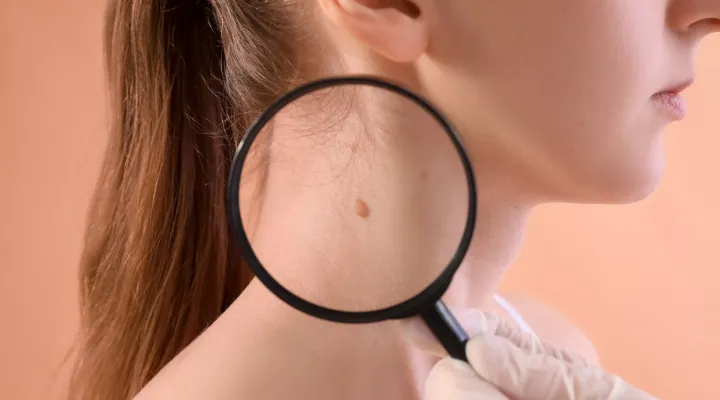
Sun exposure can leave behind more than just a tan: by the end of summer, new pigmentation may appear, existing dark spots may become more noticeable, and we may also discover moles that we had not noticed before.
Autumn is therefore a good time to take a closer look at our skin and consult a dermatologist if we notice any new or changing skin lesions.
What Happens to Our Skin During Summer?
In response to UV radiation, the skin increases its production of melanin, a natural protective mechanism that is also responsible for tanning. However, regular or intense sun exposure can leave lasting signs on the skin.
By the end of summer, freckles and pigmentation may become more pronounced, new dark spots may appear, and we may notice moles that have changed in size, colour or shape.
However, it is important to remember that not every brown spot is a mole, and not every pigmented lesion is a cause for concern. Different types of skin lesions are not always easy to distinguish without medical expertise, so if you are unsure, it is advisable to consult a dermatologist.
Pigmentation or a Mole?
Pigmentation usually appears as flat areas of discolouration caused by increased pigment production in the skin. Sun exposure, ageing and hormonal changes can all contribute to its development. These spots are particularly common on areas frequently exposed to sunlight, such as the face, décolletage, shoulders and hands.
Moles, on the other hand, are skin lesions formed by pigment-producing cells. Some are present from birth, while others may develop later in life.
Because the two can sometimes look similar, it may not always be possible to determine at home whether a newly developed or changing brown spot is simply pigmentation or a mole.
What Changes Should You Look Out For?
Regularly checking your skin can help you notice changes at an early stage. Pay particular attention if a mole:
- becomes asymmetrical;
- develops irregular or blurred borders;
- contains several different colours;
- begins to grow or changes noticeably;
- becomes itchy, bleeds, oozes or remains persistently irritated;
- looks noticeably different from your other moles.
It is not only changes in existing moles that deserve attention. A new or unusual skin lesion may also be a reason to see a dermatologist.
Why Is Dermoscopic Mole Screening Important?
During a dermatological mole screening, the dermatologist examines pigmented skin lesions using a dermatoscope. This specialised magnifying and illuminating device makes it possible to see details and structures that cannot be assessed, or are difficult to assess, with the naked eye.
The aim of the examination is to distinguish lesions that appear benign from those that may require further monitoring or treatment.
Regular screening may be particularly important for people who have many moles, have fair skin, burn easily, have experienced repeated sunburns in the past, or have a family history of melanoma.
Before treating a new pigmented spot purely as a cosmetic concern, it may therefore be worth having it examined by a dermatologist.
Autumn Is a Good Time to Check Your Skin
Sun protection does not end with summer: our skin is exposed to UV radiation throughout the year. However, after the summer months, it is particularly worthwhile to check your moles and any newly developed areas of pigmentation.
If you notice a lesion that is new, has changed, or simply causes you concern, avoid relying solely on photographs or online comparisons to decide whether it is harmless. A dermatological examination can help determine the nature of the lesion, while dermoscopic mole screening allows for a detailed assessment of moles.
- dietetics29
- pediatrics24
- diet22
- RMC Dental Center17
- internal medicine11
- dentistry11
- zsuzsanna kókai10
- pediatric dentistry9
- Dr Kinga Jókay8
- sport7
- coronavirus6
- screening6
- covid6
- urology6
- obstetrics gynecology6
- prevention5
- cardiology5
- allergy5
- psychology5
- dental hygiene5
- Kinga Jókay M.D4
- infection4
- gastroenterology4
- menopause4
- screenings3
- Flu shot3
- Flu3
- dermatology3
- women's screening3
- Dr Nóra Gullai2
- infectious disase medicine2
- Ear-Nose-Throat2
- Same Day Surgery Center2
- heat stroke2
- endocrinology2
- Dr Tímea Baló2
- allergen immunotherapy2
- Adrienne Nagy M.D.2
- Fetal Medicine Center2
- pediatric urology2
- flu season2
- meningitis2
- gynecologist2
- Ophthalmologist2
- Headache Clinic2
- Dr Eszter Bodnár2
- headache2
- menopause program2
- invisalign2
- diabetology2
- cardiovascular disease1
- diabetes1
- hydration1
- hematology1
- iron1
- Imre Bodó M.D.1
- nutritional disorder1
- lyme disease1
- gynecologic oncology surgery1
- first trimester screening1



Our related doctors

Any questions before booking an appointment?
If you are unsure which doctor to see or what examination you require, we are here to help!
Simply request a free callback from one of our colleagues, who will help you find the right specialist based on your specific issue.