
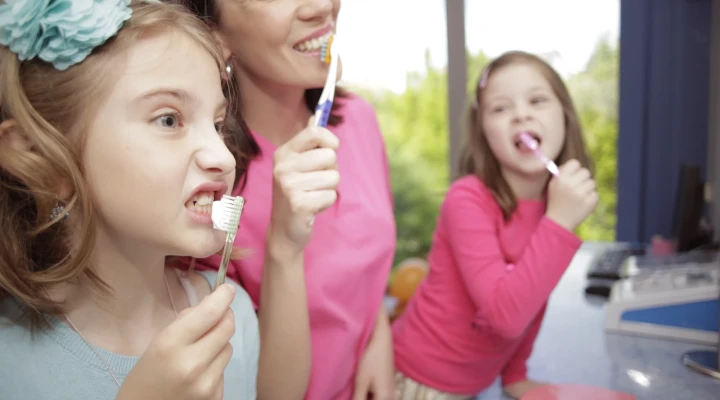
I often find that those children and parents who arrive confidently for their treatment and with a smile on their face are much more cooperative when we are carrying out the work.
You should prepare your child for dental treatment at home, in a family setting – it is really important to emphasize that it is for their own benefit. It's best to avoid statements like "it won't be too painful," "it'll soon be over" and "I know it's bad, but it doesn't last long". Instead, I recommend saying things like "now your teeth will feel much better", "we'll learn how to brush your teeth properly together", and "the tooth fairy's helpers are watching to make sure you brush your teeth properly".
It's best to schedule your child's first dental appointment when they don't yet have any issues, so they can simply come to get to know the place. One good way to do this is to bring your child along to see your own check-up – this means they can just watch and see what happens, and get used to the surroundings. This is a great time to provide the child with a playful demonstration of how dental examinations and general check-ups work. Together, we can also teach them the correct way to brush their teeth, including what kind of techniques you should use with milk teeth, mixed teeth and after their adult teeth have emerged. When necessary – if the child didn't previously brush their teeth properly – we can also apply some preventative treatment, such as polishing or plaque removal. If a child learns how to brush their teeth properly, the skill will last them a lifetime: it will help prevent tooth and gum disease, so your child can confidently smile as an adult too, and be proud of their own healthy, beautiful white teeth.
A positive first encounter with the dentist is also essential to help encourage your child to continue to attend their dental check-ups on a regular basis. Tooth decay in children's teeth occurs at a faster rate, which means their teeth can go rotten in a matter of weeks. It is especially important to take care of decaying teeth in time when children are making the transition from milk teeth to adult teeth, as newly emerging posterior molars that emerge at the end of the dental arch would otherwise grow with a not-ideal composition of mouth flora.
And finally, don't forget: it's completely normal to feel nervous, as this is a new and unfamiliar situation! Together with their parent, we help the child start on our shared path of treatment and learning with trust and confidence.
Kriszta Szabolcsy
Dental Hygienist
- dietetics28
- pediatrics24
- diet21
- RMC Dental Center16
- internal medicine11
- dentistry10
- zsuzsanna kókai9
- Dr Kinga Jókay8
- pediatric dentistry8
- sport7
- coronavirus6
- screening6
- covid6
- urology6
- obstetrics gynecology6
- prevention5
- cardiology5
- allergy5
- psychology5
- dental hygiene5
- Kinga Jókay M.D4
- infection4
- gastroenterology4
- menopause4
- screenings3
- Flu shot3
- Flu3
- dermatology3
- women's screening3
- Dr Nóra Gullai2
- infectious disase medicine2
- Ear-Nose-Throat2
- Same Day Surgery Center2
- heat stroke2
- endocrinology2
- Dr Tímea Baló2
- allergen immunotherapy2
- Adrienne Nagy M.D.2
- Fetal Medicine Center2
- pediatric urology2
- flu season2
- meningitis2
- gynecologist2
- Ophthalmologist2
- Headache Clinic2
- Dr Eszter Bodnár2
- headache2
- menopause program2
- invisalign2
- diabetology2
- cardiovascular disease1
- diabetes1
- hydration1
- hematology1
- iron1
- Imre Bodó M.D.1
- nutritional disorder1
- lyme disease1
- gynecologic oncology surgery1
- first trimester screening1


Any questions before booking an appointment?
If you are unsure which doctor to see or what examination you require, we are here to help!
Simply request a free callback from one of our colleagues, who will help you find the right specialist based on your specific issue.