
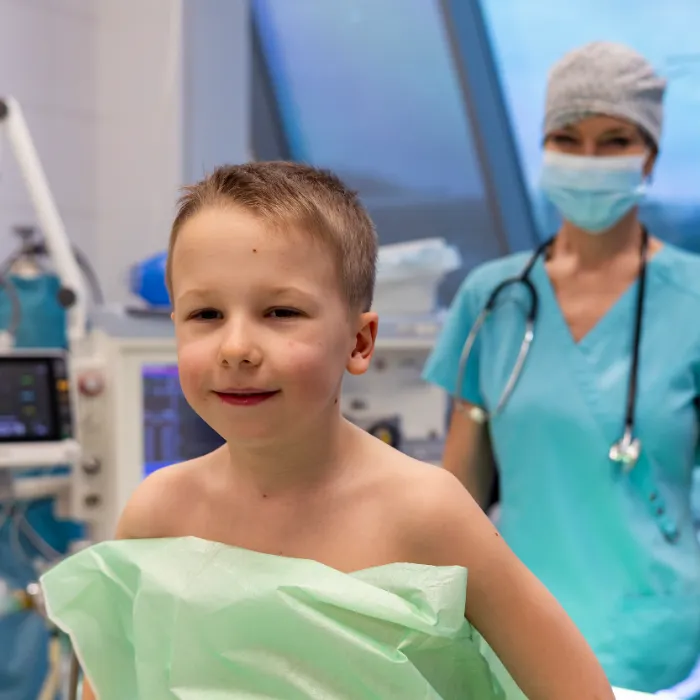
Treating children requires special expertise, as the characteristics of the developing body, the age-specific needs of children, and parental support all play an important role in the healing process. At our clinic, our experienced pediatric surgeon welcomes families in an empathetic, child-friendly environment, whether for consultation, diagnostic evaluation, or surgical treatment. A pediatric surgeon not only performs surgical procedures but also assists in establishing an accurate diagnosis, planning the appropriate treatment, and providing postoperative follow-up care.
When is it recommended to visit a pediatric surgery consultation?
A pediatric surgical examination may be recommended in the following cases, among others:
- phimosis or foreskin adhesions
- umbilical hernia or inguinal hernia
- ingrown toenail
- skin and soft tissue lesions (e.g. moles, lipomas, cysts)
- swollen lymph nodes
- undescended testicles
- anorectal complaints
- treatment of injuries and minor wounds
- recurrent abdominal pain or swelling
If parents are uncertain whether a surgical evaluation is necessary, our pediatric surgeon will gladly help determine the most appropriate course of care.
What happens during a pediatric surgical consultation?
During the consultation, the pediatric surgeon will thoroughly discuss the child’s symptoms, the onset of complaints, and previous medical history with the parents. This is followed by a physical examination tailored to the child’s age and comfort level. If necessary, additional imaging or laboratory tests may also be recommended.
At the end of the examination, the specialist explains the diagnosis, treatment options, and, if needed, the details of the surgical procedure and the expected recovery period. At our clinic, we place special emphasis on ensuring that both children and parents feel safe, comfortable, and fully informed throughout the process.
Surgical Treatment of Phimosis
Phimosis is a common condition in childhood in which the foreskin cannot be retracted properly. In infants and young children, this is often a natural condition; however, recurrent inflammation, urinary complaints, or persistent narrowing may require treatment.
The treatment method is always determined based on the child’s age and symptoms. In milder cases, conservative treatment, topical creams, or gradual stretching may be sufficient, while more severe cases may require surgical intervention.
Surgical Treatment of Umbilical Hernia
An umbilical hernia is caused by weakness in the umbilical ring, resulting in a protrusion through the abdominal wall. In many young children, the condition resolves spontaneously, therefore surgery is not always immediately necessary.
If the hernia is large, causes symptoms, or does not close spontaneously after a certain age, surgical treatment may be recommended. During the procedure, the opening in the abdominal wall is closed to prevent future complications. The surgery is considered routine, and children can usually return home after a short observation period.
Surgical Treatment of Inguinal Hernia
Inguinal hernia is a common condition in childhood, presenting as swelling in the groin area. It is typically caused by congenital factors and does not tend to heal spontaneously, therefore surgical treatment is recommended.
During surgery, the hernia sac is closed, thereby eliminating the hernia opening. Most children can go home on the same day as the procedure. Timely surgery helps prevent incarceration and other complications.
Surgical Treatment of Ingrown Toenails
An ingrown toenail is a painful inflammatory condition that commonly affects children and adolescents. It most often involves the big toe and may develop due to improper nail trimming, tight footwear, or excessive sweating.
In milder cases, local treatment and proper nail care may be sufficient. However, recurrent or severe inflammation may require a minor surgical procedure. During surgery, the ingrown edge of the nail is removed, and if necessary, correction of the nail bed is also performed. The procedure is quick, can be carried out under local anesthesia, and significantly reduces the likelihood of recurrence.
Surgical Treatment of Skin and Soft Tissue Lesions
Various skin and soft tissue lesions are common in childhood and may be congenital or develop later in life. These may include moles, cysts, lipomas, warts, inflamed skin lesions, or small lumps. Although most of these are benign, in some cases they may cause symptoms, enlarge, become inflamed, or present aesthetic concerns.
During the pediatric surgical consultation, our specialist examines the lesion, recommends further tests if necessary, and explains the available treatment options. If surgical removal is indicated, the procedure may be performed under local anesthesia or general anesthesia depending on the child’s age and the type of lesion.
The goal of surgical treatment is the safe removal of the lesion, relief of symptoms, and achieving an aesthetically favorable healing outcome. At our clinic, we place great emphasis on child-friendly care and gentle surgical techniques to ensure the least possible burden for children undergoing treatment.
Our related doctors

Any questions before booking an appointment?
If you are unsure which doctor to see or what examination you require, we are here to help!
Simply request a free callback from one of our colleagues, who will help you find the right specialist based on your specific issue.